

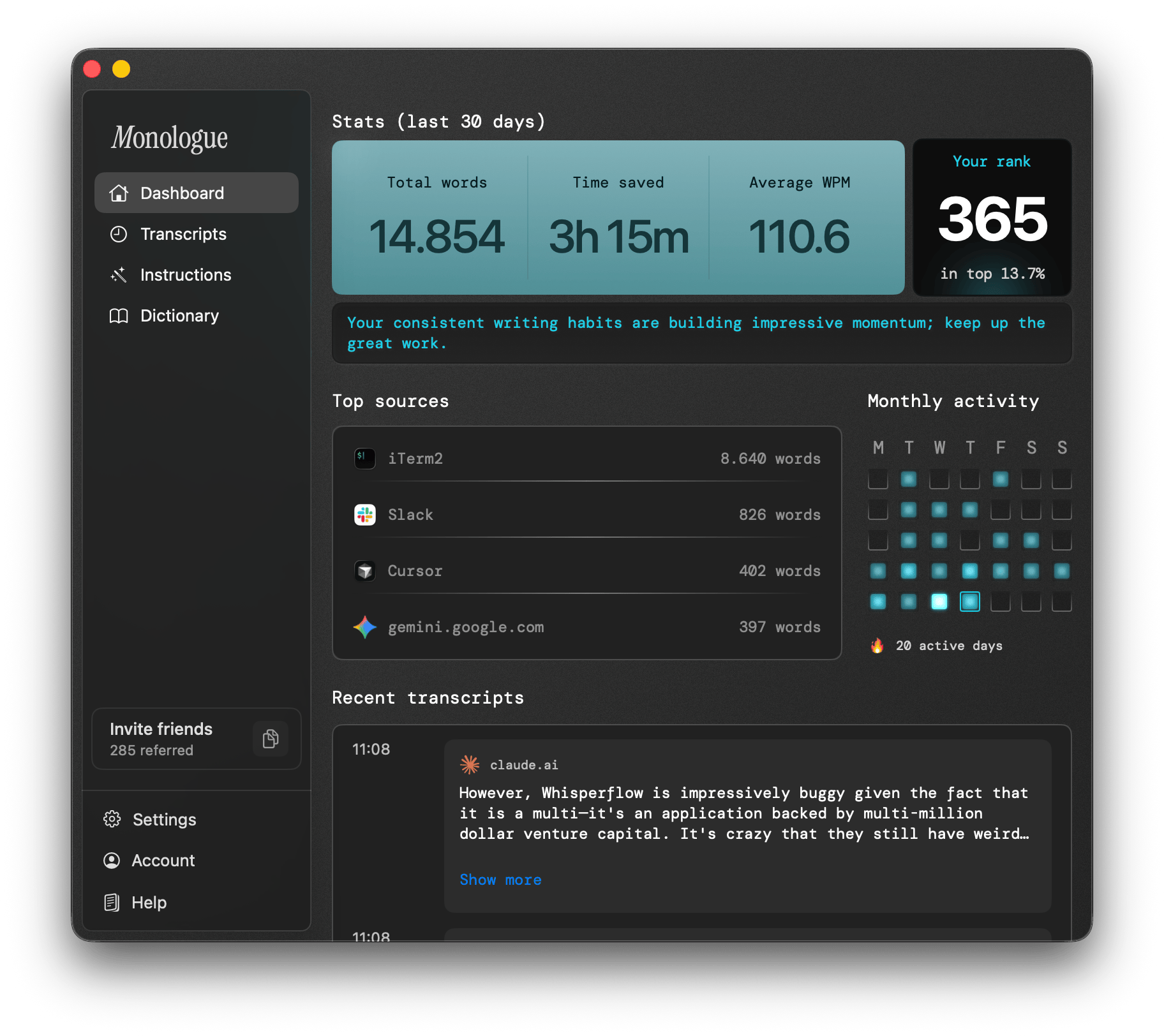
Thursday morning in my home office. Door closed, kids at school, the kind of quiet that makes dictation feel natural. I'm talking to Claude, describing what I want built. Monologue, the voice-to-text app for Mac, transcribes as I speak. The dashboard says 14,854 words this month. 156,818 overall. Twenty active days. Three hours and fifteen minutes of typing I didn't have to do.
Six months ago, I wrote about Monologue after two days of use. Let's call it the honeymoon phase. I hoped the magic would last.
It did.
How It Changed Things
The numbers tell part of the story. My top source? iTerm2, with over 8,600 words. That's me talking to Claude Code, describing components, thinking out loud while building client sites. Cursor comes next, then Slack. The pattern is clear: I speak more than I type now, especially when coding.
This wasn't the plan. I didn't download Monologue to become someone who dictates commit messages. But once you experience describing a feature out loud and watching Claude implement it while you lean back in your chair—you don't go back. The same goes for design work: describing a component I want prototyped in Gemini or Figma Make, explaining how it should look and behave, then iterating on the result. Speaking is faster than pointing and clicking through menus. It's faster than typing specs into a chat window. You just say what you see in your head.
What Gets Shipped
What impresses me most isn't any single feature. It's the pace.
Naveen, Monologue's founder and sole developer, maintains a channel on the Every Discord where users share feedback. (Every is part media company, part software incubator, part AI consulting—one subscription gets you their writing and their apps.) I asked for additional keyboard shortcuts to configure my external keyboards. It appeared in the next release. This happens constantly. Someone mentions a friction point, Naveen acknowledges it, and days later it's fixed.
This is indie software at its best. One person building something useful, listening closely, iterating fast.
The iOS-Shaped Hole
I'm out for a walk and an idea surfaces. Perfect timing—except my Mac is at home. By the time I'm back, the thought has faded.
So I've started using WisprFlow (Referral link gets us both a free month of pro) on the side. It works. Mostly. When it doesn't, I restart the app and try again. Twice this week it's crashed my entire macOS dock—strange for an app backed by $81M in funding.
But here's what excites me: Monologue's iOS app is in development. Naveen mentioned it might ship this year. And unlike WisprFlow, which wraps web technology in native wrappers, Monologue on iOS will be genuine SwiftUI. The same care that makes the Mac app feel right.
I'm rooting for the underdog here.
A Key Arrived
Speaking of underdogs: that first article I wrote back in July brought in some referrals. A lot of them, actually. Thanks to everyone who signed up through my blog.
This didn't go unnoticed. A few weeks ago, a package arrived. Inside: the Monologue signature edition MonoKey.
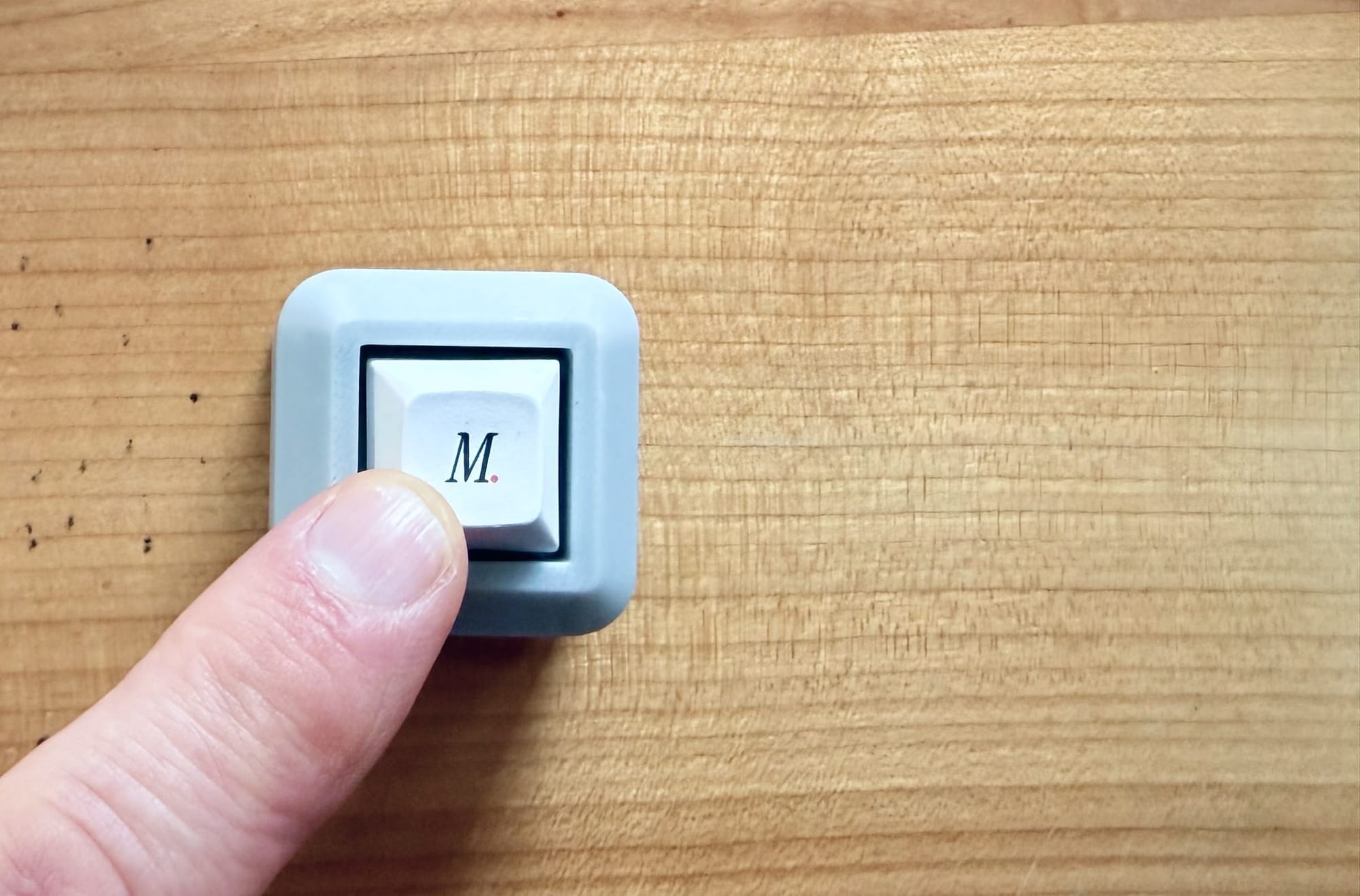
It's a physical key that triggers Monologue recordings. Just press and talk. I have it sitting on my desk, a small monument to speaking instead of typing.
Thanks, Naveen. And thanks, Every team.
Still Here
Six months in, Monologue isn't perfect. Occasionally a transcription takes longer than I'd like—a few extra seconds that feel like forever when you're in flow. Once in a while I'll manually reprocess a recording. These are small things.
What matters is this: I use it every day. For Claude prompts, for Slack messages, for thinking out loud into Craft. The custom dictionary still respects my German place names or French travel destinations. The smart formatting still surprises me.
Is this the honeymoon phase? After six months, I don't think so. This is just how I work now.
Try Monologue with my referral link

PS: Counting months is hard, apparently. Right after publishing this article I realized that July to December are, of course, five months 🤷
Discussion